
Apache Airflow consulting and hands-on support
Apache Airflow consulting services to design, harden, and scale workflow orchestration for data and ML pipelines with reliable, cost-aware operations. We deliver reference architecture, DAG standards, Kubernetes deployment patterns, CI/CD automation, and observability with runbooks so teams can operate Apache Airflow confidently at scale.
Last updated
- 4.9/5 on Clutch
- Top 0.7% of DevOps engineers
- Billed by the hour, no lock-in

- Consulting
- Hands-on work
- Architecture
Trusted by teams shipping production infrastructure




%2520(2).avif&w=3840&q=75)

.avif&w=3840&q=75)



The hard part
Finding great Apache Airflow help is its own project
Hiring a strong Apache Airflow engineer, for the hours you actually need, is slow, risky, and expensive. Here is what teams keep running into.
Months wasted hunting for a specialist who actually knows Apache Airflow.
The wrong hire after weeks of interviews and onboarding.
Full-time cost when the workload is genuinely part-time.
Tech debt compounds while Apache Airflow sits half-finished between sprints.
The roadmap stalls every time Apache Airflow work lands on the wrong desk.
From first message to shipped Apache Airflow work
Starting is light and reversible. You see the plan and meet your engineer before a single hour is billed. Here is the whole path.
- 1
Tell us what you need
A short call to understand your current Apache Airflow setup, the constraints, and the result you are after.
- 2
We shape the plan
You get a written Apache Airflow work plan: the approach, the trade-offs, and the first steps, adjusted around your input.
- 3
Meet your engineer
We match you with the senior engineer on our team best suited to your Apache Airflow work. No hour is billed before this.
- 4
We do the work
Your engineer joins the team, ships the hands-on Apache Airflow work, and keeps consulting you at every step.
Runs throughout, start to finish
- Shared Slack channelWhere we update and discuss the work, day to day.
- Weekly syncsA standing cadence to review progress, blockers, and the next steps, with a written summary.
- Pay as you goUse as many hours as you need. No retainer, no lock-in.
- Free architect inputAn architect from our team joins the discussions to enrich the plan, at no charge.
A conversation first. You decide whether to go further.
Embedded in your team, not an agency over the wall
Your Apache Airflow engineer joins your team and your tools and works alongside you, with the rest of ours on call behind them.
- Your engineer
Everything in our Apache Airflow service
Consulting and hands-on work from the same senior engineer, billed by the hour.
A senior Apache Airflow expert advising you
We hire 7 engineers out of every 1,000 we vet, so you get the top 0.7% of Apache Airflow experts.
A custom Apache Airflow plan that fits your company
A flexible process turns your goals into a custom Apache Airflow work plan built around your requirements.
You pay only for the hours worked
Use as many hours as you like, zero, a hundred, or a thousand. It is completely flexible.
The same expert does the hands-on Apache Airflow work
Our Apache Airflow service goes past advice: the person consulting you joins your team and does the hands-on work.
Perspective from many Apache Airflow setups
Our experts have worked with many companies and seen plenty of Apache Airflow setups, so they bring real perspective on yours.
An architect's input on the Apache Airflow decisions
On top of your Apache Airflow expert, an architect from our team joins the discussions to enrich the plan.
Teams that stopped firefighting
The same senior engineers, on real production work. A recent study, and what clients say once the dust settles.
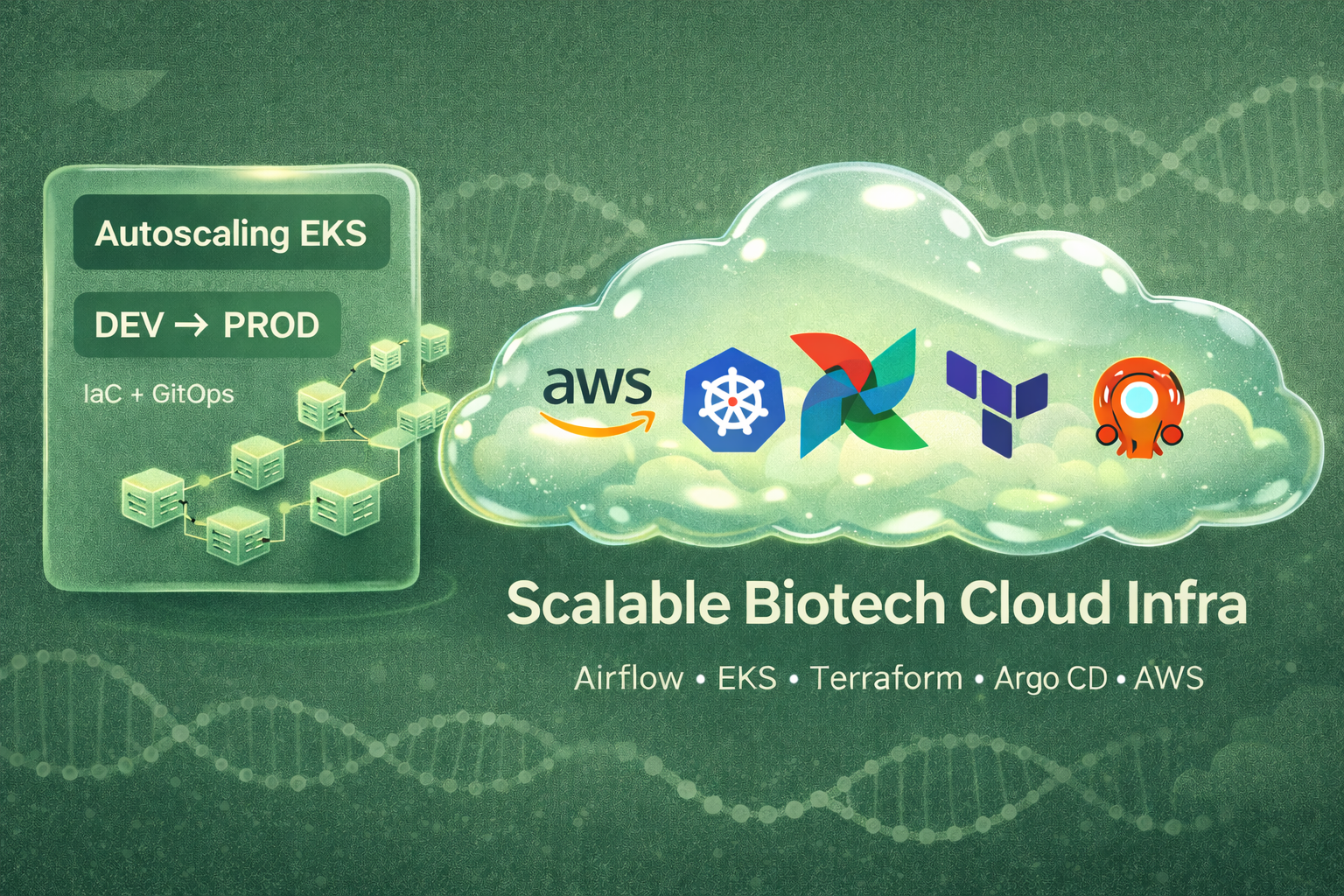
Scalable Biotech Cloud Infrastructure with Apache Airflow, Kubernetes, AWS, and Terraform
Turned a custom, untracked data-pipeline setup into a fully IaC, GitOps-driven Airflow-on-Kubernetes platform on AWS.
- Airflow
- Kubernetes
- AWS
- Terraform
- Argo CD
Thanks to MeteorOps, infrastructure changes have been completed without any errors. They provide excellent ideas, manage tasks efficiently, and deliver on time. They communicate through virtual meetings, email, and a messaging app. Overall, their experience in Kubernetes and AWS is impressive.

Good consultants execute on task and deliver as planned. Better consultants overdeliver on their tasks. Great consultants become full technology partners and provide expertise beyond their scope. I am happy to call MeteorOps my technology partners as they overdelivered, provide high-level expertise and I recommend their services as a very happy customer.

Tell us about your Apache Airflow project
A couple of lines is enough. We come back with a quick read on the work, a rough shape of the plan, and the senior engineer who fits.
- A senior engineer reads it, not a sales rep
- We reply within a few hours
- Billed by the hour if you go ahead, no lock-in
A bit about Apache Airflow
Things you need to know about Apache Airflow before choosing a consulting partner.
What is Apache Airflow?
Apache Airflow is an open-source workflow orchestrator for defining, scheduling, and monitoring batch data and machine learning pipelines as code. It is commonly used by data engineering and MLOps teams to coordinate ETL/ELT jobs, dataset refreshes, and operational tasks across databases, warehouses, object storage, and cloud services with clear dependency control and run visibility. See the Apache Airflow documentation for details.
Workflows are authored in Python as Directed Acyclic Graphs (DAGs) and typically run on shared infrastructure, scaling from a single node to distributed execution with options like Kubernetes or Celery executors.
- Code-defined DAGs with explicit task dependencies
- Scheduling, retries, backfills, and failure handling
- Operators, sensors, and hooks to integrate common systems
- Web UI for monitoring runs, logs, and task history
- Role-based access control for multi-team environments
Why use Apache Airflow?
Apache Airflow is an open-source workflow orchestrator for defining, scheduling, and monitoring batch data and ML pipelines as code. It is used when teams need explicit dependency management, reliable execution controls, and clear operational visibility across multi-step workflows.
- Python-authored DAGs keep orchestration logic version-controlled, testable, and reviewable alongside application code.
- Explicit task dependencies model complex pipelines and enforce correct execution order across systems.
- Flexible scheduling supports cron-like intervals, event-style manual triggers, backfills, and catchup for historical reprocessing.
- Built-in reliability controls such as retries, timeouts, SLAs, and failure callbacks reduce manual intervention.
- Operational UI and rich metadata make it easier to inspect run history, task state, logs, and bottlenecks during incidents.
- Extensive provider packages and operators integrate with common warehouses, databases, object storage, and APIs.
- Executor options (Local, Celery, Kubernetes) allow scaling from a single host to distributed task execution.
- Parameterization, templating, and dynamic DAG patterns support reusable workflows and high-variation pipelines.
- Centralized metadata database improves auditability and enables reporting on pipeline health and reliability.
- Role-based access control and permissions help govern who can view, trigger, and modify workflows.
Airflow is typically a strong fit for dependency-heavy, batch-oriented pipelines and scheduled operational workflows. It is less suitable for low-latency streaming orchestration, and production deployments require attention to scheduler performance, metadata database health, and disciplined DAG design to avoid brittle workflows.
Common alternatives include Prefect, Dagster, and Argo Workflows. For implementation details and best practices, see the Apache Airflow documentation.
Why get our help with Apache Airflow?
Our experience with Apache Airflow helped us build repeatable delivery patterns for workflow orchestration—covering architecture, DAG engineering, and day-2 operations—so clients can run dependable batch data and ML pipelines with clear ownership, predictable scheduling, and actionable monitoring.
Some of the things we did include:
- Designed reference architectures for Airflow across AWS, GCP, and Azure, aligning executor choice, scaling model, and failure domains to workload characteristics and team operating model.
- Built production-grade Airflow on Kubernetes with Helm, including safe upgrade practices, autoscaling, resource requests/limits, node affinity/taints, and runbooks for common incidents.
- Implemented CI/CD for DAGs and Airflow configuration (linting, unit tests, packaging, environment promotion), with dependency pinning and provider version control to reduce upgrade risk.
- Standardized DAG patterns for idempotency, retries, SLAs, backfills, sensors/timeouts, and dataset-aware scheduling to reduce noisy failures and improve on-call predictability.
- Integrated Airflow with dbt for analytics transformations, including environment-aware configs, artifact handling, and lineage-friendly naming conventions.
- Orchestrated batch processing via Airflow integrations with Apache Spark and Databricks, including parameterized job submission, concurrency controls (pools/queues), and robust retry semantics.
- Improved observability by wiring logs and metrics into existing stacks (e.g., Prometheus), adding scheduler/worker health checks, DAG-level SLOs, and actionable alerting.
- Hardened security with least-privilege IAM, secret management, network controls, and controlled plugin/provider usage, plus audit-friendly change controls.
- Optimized performance and cost by tuning parallelism, pools, scheduling intervals, worker sizing, and by replacing inefficient sensor patterns with event-driven approaches where appropriate.
- Planned and executed migrations from legacy schedulers and older Airflow versions, including compatibility testing, staged cutovers, and rollback plans to minimize downtime.
- Implemented HA/DR practices for the metadata database and scheduler redundancy, including backup/restore procedures and validated recovery steps through tabletop and live tests.
This delivery experience helped us accumulate significant knowledge across ETL, analytics, and ML pipeline orchestration use-cases, enabling us to deliver high-quality Apache Airflow setups that are maintainable, scalable, secure, and supportable in real production environments.
How can we help you with Apache Airflow?
Some of the things we can help you do with Apache Airflow include:
- Audit your current Airflow environment and deliver a prioritized findings report across reliability, maintainability, security, and scaling risks.
- Define an adoption roadmap with standardized DAG patterns, dependency management, and promotion workflows across dev/test/prod.
- Design and implement production-grade Airflow (self-managed or managed) with HA architecture, executor selection, and resilient scheduling.
- Automate infrastructure and releases using Infrastructure as Code, CI/CD, and GitOps-style workflows to reduce drift and deployment risk.
- Harden security with RBAC, secrets management, network controls, and compliance guardrails aligned to your data policies.
- Improve observability with metrics, logs, alerting, and SLOs to shorten incident response and reduce pipeline downtime.
- Optimize cost and performance through right-sized workers, autoscaling strategies, queue/concurrency tuning, and efficient task design.
- Refactor and troubleshoot DAGs, operators, and dependencies to reduce retries, eliminate bottlenecks, and improve data freshness.
- Enable teams with hands-on training, code reviews, and playbooks for maintainable, testable pipeline development and operations.
- Provide ongoing operations support for upgrades, plugin governance, and reliability improvements as your orchestration footprint grows.
For background on core concepts and best practices, see the official Apache Airflow documentation.
Keep exploring
Explore more technologies
Other tools and platforms our engineers work with, alongside Apache Airflow.
 External Secrets OperatorSyncs external secrets into Kubernetes, reducing credential exposure and configuration drift
 ElasticsearchIndexes and searches large datasets quickly for low-latency insights and analytics
 BitBucketManages Git repositories with integrated CI/CD.
 AWS ECSOrchestrates containers on AWS to simplify deployment, scaling, and operations
 LinuxRuns server and cloud workloads reliably with strong security controls and flexibility
 VagrantProvisions reproducible VM-based development environments, reducing onboarding time and configuration drift


